Monday, July 23, 2007

Uncle Dave and the "Donner Party"

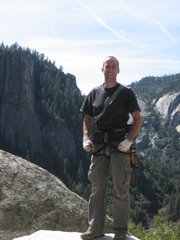
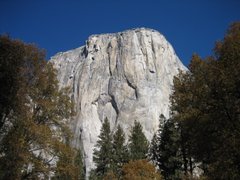
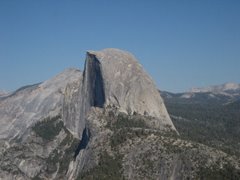
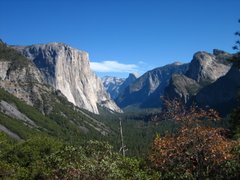
This past weekend I was climbing up in the Donner Memorial State Park at Donner Summit. This state park was named after the ill fated Donner Party. The Donner Party was a group of California bound American settlers caught up in the "westering fever" of the 1840's. After becoming snowbound in the Sierra Nevada in the winter of 1846 - 1847, some of the emigrants resorted to cannibalism. Although this aspect of the tragedy has become synonymous with the Donner Party in the popular imagination, it actually was a minor part of the episode. There were truly spectacular views of Donner Lake from the Summit climbing areas (photo) although the heat was a little hard to handle even at 7000 feet. The climbing, on Granite, was good but really paled in comparison to the huge and enormously impressive granite domes of the Tuolumne Meadows in Yosemite NP, where I spent the previous weekend.

The Donner Pass is where the First Transcontinental Railroad in the United States crosses the Sierra Nevada Mountains. This railroad linked the Eastern United States to California and the Pacific Coast and was completed in 1869. Its completion initiated a nationwide mechanised transportation network that revolutionized the population and economy of the American West. This network caused the wagon trains of previous decades to become obsolete, exchanging it for a modern transportation system. To protect the railroad and keep the tracks open year round, wooden sheds were constructed over the tracks (see top right photo below) especially during the heavy winter snowfalls.
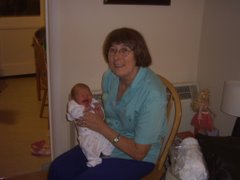
Even more interesting is my recent ascension to the ranks of Uncle Dave - WOW do I sound old now! My niece, Teyha, was born on 16th July and weighed in at a health 7lbs something. I look forward to meeting her very soon but until then we will both just have to get by on on photos and stories alike.

Cheers

Dave

Saturday, June 09, 2007

"Les cloches du mariage" at the Beau Rivage

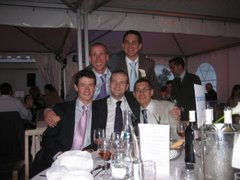
The 2nd of June saw the 2nd marriage of my under graduate "Derby Grove" housemates. This time it was Jon the Hands (and yes there were significant mentions of his gigantic digits during the Best Man's speech - nice one Phil!) finally marrying Paula after some 10 years together. It was a tremendous wedding, very befitting to both the Bride and Groom (see above), on the beachfront in Nice. They certainly broke some new ground with respect to some of the more traditional aspects of a wedding. There were 4 best men, the wedding ceremony was conducted by two of the best men and the top table was distinctly absent of any of the olds. Great food, plenty of booze and good weather (well for the most part) all added to the occasion and I was very happy to have made the 5000 mile trip and to have been apart of the celebrations!

Jon and Paula - I probably said it already but you guys are perfect for each other and I wish you all the happiness and success in your future together. See you both in a few weeks.

All the best,

Dave

Birthday Booze Up - Champagne Charlies Stylee

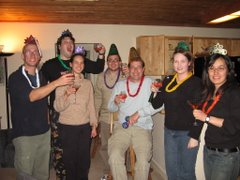
What better way to see in my penultimate 20's birthday than drinking uncountable amounts of "Whallop" from pewter tankards at Champagne Charlies in Charing Cross with a selection of my favourite drinking partners! The reviews of the establishment were less than flattering but it was Friday in London and we had seats even though they were in a broom cupboard with out of control heating. In addition to the Whallop and some cheap champers there was cake though I only remember eating it after seeing the photos. I can't even remember who brought it so thanks!

Definitely feeling my age these days as I felt horrible for several days afterwards. I blame the jetlag myself, the farcical amount of booze could not have been a factor!

Cheers guys - it was a blast!

Dave

The Olds in CA

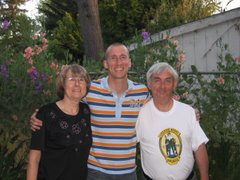
Back in April, my Olds made their first visit to both the US and California and as I have been a little slack on the Blog front these past few months I am only just getting around to posting about it now.

What with the restrictive holidays and the requirement to return to the UK for at least two weeks in order to have my visa re-issued I could not spend as much time with them as I would have liked but they still had a great time from what I could glean.

The first week I sent them out of state to see Las Vegas (no first trip to the US would be complete without seeing the overindulgent opulence for oneself) and the Grand Canyon. My mother is a big fan of Egypt and so it was a no brainer as to where they ended up staying - The Luxor on the strip. As far as I understand they were suitably impressed by the grandness of the canyon and somewhat surprised by the snow. They stayed in Williams, near Flagstaff in what used to be a brothel during the pioneer days - the aptly named Red Garter hotel! Highly recommended for any of you that are ever passing through Arizona.

The second week was spent exploring San Fransisco, Berkeley and the central coast, namely Santa Cruz and Big Sur. Santa Cruz is the reputed site of the first surfing in California in 1885 and has 11 world class surf breaks, including the point breaks over rock bottoms near Steamer's Lane and Pleasure Point, which create some of the best surfing waves in the world. Santa Cruz hosts several surf contests drawing international participants each year. The Santa Cruz Beach Boardwalk (not dissimilar to the Great Yarmouth Pleasure with the exception of almost certainly warmer weather) is California’s oldest amusement park and a designated State Historic Landmark. Big Sur is a sparsely populated region of the central Californian coast where the Santa Lucia Mountains rise abruptly from the Pacific Ocean creating a landscape that is dramatic with stunning views. Highway 1 runs from San Fransisco through Big Sur to Los Angeles and hugs the rugged coastline as it goes making for a very dramatic drive.

For the penultimate weekend we all went to the National Railroad Museum in Sacramento and what better way to travel than by Amtrak train from Berkeley. Proving that the limited yet integrated public transport system in this part of the states actually works pretty well. The Bay Area Rapid Transit or BART train (something not unlike the London Tube, though with far less coverage) links up with the regional Amtrak services in Richmond and from there its a smooth 1.5 hour ride to the Californian Capitol. The Museum dates back to 1956, when local individuals advanced the concept of a national museum dedicated to the American rail road history. Two years later, a joint resolution of Congress recognized the Museum as the National Railroad Museum. Since then, the Museum has operated as a privately funded educational organization with a mission to foster an understanding of railroading and its significance to American Life. What began as an effort to acquire a single steam locomotive for a city park has grown into one of the largest rail museums in the nation and now sees over 75,000 visitors annually. The documented endeavors of forcing a railroad through the inhospitable Sierra Nevada Mountains and the significant challenge of keeping the tracks clear during the heavy winter snow storms made for some very interesting reading. In the summer months live steam rides add to the excitement and appeal and we were fortunate enough to be able to take advantage of this added bonus during our visit.

For the final week I sent my folks to explore Yosemite NP (no trip to California would be complete without seeing the most visited, 3.5 million visitors annually, NP in California). The park was the first to set aside by the U.S. federal government and covers an area of 761,266 acres or 1,189 square miles (3,081 km²) and reaches across the western slopes of the Sierra Neveda Mountains. Yosemite NP was designated a World Heritage Site in 1984 and is internationally recognized for its spectacular granite cliffs, numerous waterfalls and Giant Sequoia groves. The geology of the park is characterized by granitic rocks and the remnants of older rock. About 10 million years ago, the Sierra Nevada was uplifted and then tilted to form its relatively gentle western slopes and the more dramatic eastern slopes. The uplift increased the steepness of stream and river beds, resulting in formation of deep, narrow canyons. About 1 million years ago, snow and ice accumulated, forming glaciers at the higher alpine meadows that moved down the river valleys. Ice thickness in Yosemite Valley may have reached 4,000 feet (1200 m) during the early glacial episode and sculpted the U-shaped valley that is the focal point of the park today.

Laters,

Dave

Saturday, March 24, 2007

TAG, the GRC and CMU

For the last few weeks, work has been really hectic. Firstly, with a week spent at the Gordon’s Research Conference (GRC) on Biogenic Hydrocarbons and the Atmosphere, though really with a name like Gordon’s you might have expected it to be about Gin! Though there was a fair amount of drinking during the poster sessions (photo 1). The conference was in Ventura, a coastal town between Santa Barbara and Los Angeles. Interestingly, for all you film buffs, the hotel (photo 2) where it was based appears at the end of the movie “Little Miss Sunshine”. It was a real multidisciplinary affair with talks ranging from genetics and genetic engineering to ecology and air quality and with any conference some of the talks were engaging and inspiring and a few left you struggling to stay awake!

For the last three weeks I have been at Carnegie-Mellon University (CMU) in Pittsburgh, Pennsylvania installing a version of our Thermal desorption Aerosol GC-MS/FID (TAG) instrument (photo 3), that Aerosol Dynamics Inc. sold them and training one of their graduate students. It was a challenged period with at least a years worth of ‘unforseen’ technical problems. However, even in the face of such adversity we kept our sense of humours through it (photo 5). The graduate student had the look of “what have I got myself into?” on his face for many of the days! Eventually however, after a string of very long days and plenty of elbow grease and hard work we finally began to make some head away.

CMU was formed in 1967 from the merging of the Carnegie Institute of Technology (founded in 1900 by Scottish-American industrialist and philanthropist Andrew Carnegie) and the Mellon Institute of Industrial Research (founded in 1913 by Andrew Mellon and his brother Richard). Andrew Carnegie was the founder of the Carnegie Steel Company which later became U.S. Steel. He is known for having built one of the most powerful and influential corporations in United States history, and, later in his life, giving away most of his riches to fund the establishment of many libraries, schools, and universities in Scotland, America, and worldwide. Carnegie, a poor boy with fierce ambition, a pleasant personality, and devoted to both hard work and self improvement, started as a telegrapher. By the 1860s he had investments in railroads, railroad sleeping cars, as well as bridges and oil derricks, and built a fortune as a bond salesman raising money in Europe for American enterprises. Steel was where he found his fortune. In the 1870s he founded the Carnegie Steel Company, a step which cemented his name as one of the “Captains of Industry”. By the 1890s it was the largest and most profitable industrial enterprise in the world. He sold it to J.P. Morgan's US Steel in 1901 and devoted the remainder of his life to large scale philanthropy, with special emphasis on local libraries, world peace, and scientific research. Recently, the university spent 1 million dollars of student tuition fees installing this biazaar sculpture (photo 4) entitled ‘walking to the sky’ – I wonder what Carnegie and the 'pair of Mellons' would have made of it?

The weather on the flight over and during the first week and the final few days was the closest I have come to real winter since leaving the UK. The weather in the mid-west is a far cry from the delights of the California. There has been plenty of snow in Pittsburgh while Berkeley was enjoying highs of 80F and during the layover in Chicago on the flight over, the plane became covered in snow and ice (photos 6 and 7), so much so that it was necessary to sprayed down the plane with anti-freeze before we could take off into a snow blizzard! During my time in Pittsburgh we experience all four seasons in about 8 days; the weather started cold and then warmed up to give one day of glorious sunshine, three of rain and cloud before the snow and freezing temperatures returned. The cold made California all the more welcoming when I finally returned yesterday.

Laters

Dave

PS. Check out my new work webpage at http://nature.berkeley.edu/~dworton

Saturday, March 10, 2007

Climate Skeptics: Read on....

Since Channel 4 aired a show called "the great global warming swindle" this week, I have received numerous emails asking me to clarify the link between anthropogenic (that is man-made) activities and global warming. Fortunately, a response highlighting the flaws in the arguments put forward by the show has been posted on the RealClimate website, which I have posted below. Hopefully, this should erase any doubts you may have about human induced climate change and convince you that the only swindling going on is by the makers of this show!

On Thursday the 8th, the UK TV Channel 4 aired a programme titled "The Great Global Warming Swindle". We were hoping for important revelations and final proof that we have all been hornswoggled by the climate Illuminati, but it just repeated the usual specious claims we hear all the time. We feel swindled. Indeed we are not the only ones: Carl Wunsch (who was a surprise addition to the cast) was apparently misled into thinking this was going to be a balanced look at the issues (the producers have a history of doing this), but who found himself put into a very different context indeed.

So what did they have to say for themselves?

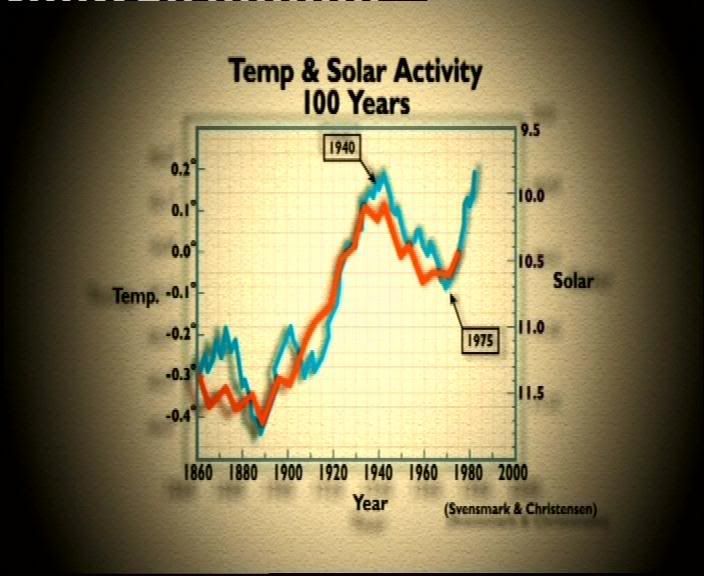
CO2 doesn't match the temperature record over the 20th C. True but not relevant, because it isn't supposed to. The programme spent a long time agonising over what they presented as a sharp temperature fall for 4 decades from 1940 to 1980 (incidentally their graph looks rather odd and may have been carefully selected; on a more usual (and sourced!) plot the "4 decades of cooling" is rather less evident). They presented this as a major flaw in the theory, which is deeply deceptive, because as they and their interviewees must know, the 40-70 cooling type period is readily explained, in that the GCMs are quite happy to reproduce it, as largely caused by sulphate aerosols. See this for a wiki-pic, for example; or (all together now) the IPCC TAR SPM fig 4; or more up-to-date AR4 fig 4. So... they are lying to us by omission.

The troposphere should warm faster than the sfc, say the models and basic theory. As indeed it does - unless you're wedded to the multiply-corrected Spencer+Christy version of the MSU series. Christy (naturally enough) features in this section, though he seems to have forgotten the US CCSP report, and the executive summary which he authored says Previously reported discrepancies between the amount of warming near the surface and higher in the atmosphere have been used to challenge the reliability of climate models and the reality of human induced global warming. Specifically, surface data showed substantial global-average warming, while early versions of satellite and radiosonde data showed little or no warming above the surface. This significant discrepancy no longer exists because errors in the satellite and radiosonde data have been identified and corrected. New data sets have also been developed that do not show such discrepancies. See-also previous RC posts.

Temperature leads CO2 by 800 years in the ice cores. Not quite as true as they said, but basically correct; however they misinterpret it. The way they said this you would have thought that T and CO2 are anti-correlated; but if you overlay the full 400/800 kyr of ice core record, you can't even see the lag because its so small. The correct interpretation of this is well known: that there is a T-CO2 feedback: see RC again for more.

All the previous parts of the programme were leading up to "so if it isn't CO2, what is it?" to which their answer is "solar". The section was curiously weak, and largely lead by pictures of people on beaches. It was somewhat surprising that they didn't feature Svensmark at all; other stuff we've commented on before. Note that the graph they used as "proof" of the excellent solar-T connection turns out to have some problems: see figure 1c of Damon and Laut.

Along the way the programme ticked off most of the other obligatory skeptic talking points: even down to Medieval English vineyards and that old favourite, volcanoes emitting more CO2 than humans.

It ended with politics, with a segment blaming the lack of African development on the environmental movement. We don't want to get into the politics, but should point out what the programme didn't: that Kyoto exempts developing nations.

[Also: other discussion at InTheGreen, Stoat and The Guardian.]

Monday, February 19, 2007

Presidents Day Weekend

This weekend saw another very welcome bank holiday weekend - Presidents Day. The origins of the holiday dates back to the Uniform Monday Holiday Bill of 1968, which became effective in 1971 and celebrates both George Washingtons (February 22nd; 1st US president 1789 - 1797) and Abraham Lincolns (February 12th; 16th US president 1861 - 1865) Birthdays. Although my impression is that the day celebrates all the US presidents.

This weekend the weather was absolutely spectacular considering its February - there isn't really much of a winter in the bay area - and I promised myself that I would not do any long road trips or work the whole weekend. So early on Saturday I went with Vince, a friend from the Christmas Joshua Tree trip, to the Consumnes River Gorge to climb. The climbing here was in a spectacular setting (photo 1 - me at the start of the second pitch) with the longest routes beginning on boulders in the river and heading up a 500 foot face (photo 2 - view down from the summit). It turned into something of an 3 pitch epic requiring 6 rappels to descend (photos 3 and 4 - Vince on the penultimate and final rappels) due to the wide spacing of the fixed rappel bolts meant we had to move diagonally between two sets of fixed bolts on the face - we have been nice to have know we needed double ropes, ah well, you live and learn!

The Amgen Tour of California bike race began on Sunday with a time trial race in San Fransisco. The first of the 7 stages starting today at Sausalito and traversed ~100 miles through Marin County finishing at Santa Rosa. Myself and Tim, a friend from UC Berkeley, rode out through Marin and intersected the race about 10 miles in at the top of the hill sprint. In the shade it was pretty chilly except on the hill climbs so soaking up the sun at the top of the hill sprint turned out to be a perfect break, shame that my camera battery was dead as there were so great views both out over the Pacific Ocean and down onto the Golden Gate Bridge and San Fransisco.

Laters

Dave